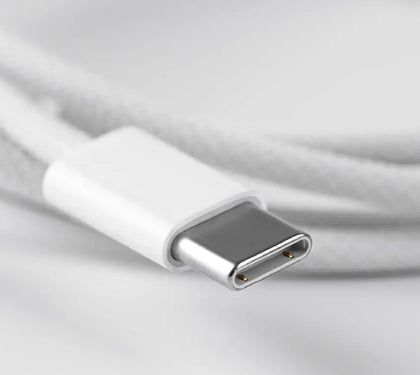


USB-C has become a common connection interface for laptops, tablets, smartphones, meeting room equipment, and external displays. Its compact, reversible connector can support charging, data transfer, video output, and peripheral connectivity.
The challenge is that two identical-looking USB-C cables may support completely different functions.
Some cables are designed mainly for charging. Others support high-speed data transfer, high-wattage USB Power Delivery, or video output through DisplayPort Alternate Mode. Looking at the connector alone makes it easy to choose a cable that does not meet the application requirements.
1. USB-C Cables May Look the Same but Support Different Functions

The capabilities of a USB-C cable depend on its internal wiring, available high-speed lanes, E-Marker chip, and compliance with the relevant USB, Power Delivery, and video transmission specifications.Two USB-C to USB-C cables may look exactly the same but support very different functions. One may handle basic charging only, while another can carry high-speed data, video, and high-wattage power at the same time.Common differences include:
- Maximum charging power
- USB Power Delivery support
- E-Marker support
- USB 2.0, USB 3.2, or USB4 data speeds
- 4K or 8K video output
- Signal stability at different cable lengths
Don’t just ask, “Is it USB-C?” Ask what it can actually do.
2. Check These Three USB-C Cable Specifications First

Before choosing a USB-C cable, start with three core specifications: Charging power, Data transfer speed and Video output capability.
2.1 Charging Power: Does the Cable Support USB Power Delivery?

Charging power is often the first specification listed for a USB-C cable. For laptops, tablets, and other high-power devices, make sure the cable supports the wattage required by the application.Common USB-C charging levels include:
-
Standard USB-C charging: Up to 60 W
Suitable for smartphones, tablets, and lightweight laptops
-
USB PD 3.0: Up to 100 W
Suitable for business laptops and most mainstream USB-C laptops
-
USB PD 3.1 EPR: Up to 240 W
Suitable for high-performance laptops, mobile workstations, and professional equipment
For charging above 60 W, the cable typically needs to support 5 A current and include an E-Marker chip. The E-Marker allows connected devices to identify the cable’s capabilities and confirm whether it can safely carry higher current and power levels.
High-wattage charging does not guarantee video output.
USB Power Delivery determines how much power the cable can carry. It does not define whether the cable can transmit a video signal. A cable may support 100 W or 240 W charging and still be unable to connect a laptop to an external display or meeting room display system.
2.2 Data Transfer Speed: What Is the Difference Between USB 2.0, USB 3.2, and USB4?

The next specification to check is data transfer speed. Depending on the cable, USB-C data rates can range from 480 Mbps to 40 Gbps.
In a BYOD meeting room, one USB-C connection may need to support several devices at once, including USB cameras, microphones, speakerphones, touch displays, USB hubs, and KVM devices.
Available data bandwidth directly affects the stability of these connected devices.
For example:
- A USB camera requires stable data bandwidth.
- A touch display requires a USB data return path.
- A KVM system needs USB data for keyboard and mouse control.
A low-speed USB-C cable can cause peripherals to go undetected, disrupt USB video capture, or introduce delays in keyboard and mouse control.
High-speed USB data does not guarantee video output.
USB data speed and DisplayPort Alt Mode are separate capabilities. Do not rely only on the Gbps rating. Confirm whether the cable is also suitable for video output.
2.3 Video Output: Does the Connection Support DP Alt Mode?

The third core specification is video output. This is where USB-C labels often cause the most confusion.
USB-C itself is a connector type, not a video signal format. To output video through USB-C, the source device, cable, and receiving equipment must support the required video transmission method.
One of the most common methods is DisplayPort Alternate Mode, usually called DP Alt Mode.
DP Alt Mode allows a USB-C connection to carry a DisplayPort video signal. A compatible laptop can then send video to:
- An external monitor
- A projector
- A USB-C display
- A USB-C to HDMI adapter
- A USB-C presentation switcher
If the cable, laptop, or an intermediate device does not support video output, the laptop may charge while the display stays blank.
USB-C video output depends on the entire signal path—not the cable alone.
3. Why Can a USB-C Cable Charge a Laptop but Not Connect to a Display?
Charging, USB data, and video output are separate functions.
| Issue | Possible Cause |
|---|---|
| The laptop charges, but no image appears | The cable, laptop, or connected equipment does not support DP Alt Mode video output |
| USB data works, but no image appears | USB data support does not guarantee video output |
| The image appears but flickers | Insufficient cable bandwidth, unstable cable quality, or excessive cable length |
| 4K video does not display correctly | The cable, adapter, switcher, or display does not support the target resolution |
| No signal appears when connected to meeting room equipment | One part of the signal path does not support the required function |

A working USB-C video connection depends on every part of the signal path:
- The laptop’s USB-C port supports video output.
- The USB-C cable supports the required video transmission.
- The extender supports USB-C DP Alt Mode, such as the SC&T UKM01P-4K6G.
- The monitor or projector supports the target resolution.
- EDID communication and display negotiation work correctly.
One unsupported link in the signal path can prevent the video from reaching the display.
For laptop-to-display connections, DP Alt Mode is one of the first things to check.
4. Choose the Right USB-C Cable for a BYOD Meeting Room
In a BYOD meeting room, a USB-C cable often needs to do more than charge a device. It may need to carry video, USB data, power, and peripheral signals at the same time.
Packaging labels are useful, but each label may describe only one part of the cable’s capabilities.

| Common Label | Common Misunderstanding | What It Actually Means |
|---|---|---|
| 100 W / 240 W | The cable supports every USB-C function | The label indicates charging power only and does not confirm video support |
| 5 Gbps / 10 Gbps | A fast cable can always connect to a display | The label indicates USB data speed, not video output capability |
| 40 Gbps | The cable supports every possible function | Device-side support and video output capability must still be confirmed |
| 4K / 8K | High-resolution video will always be stable | Refresh rate, cable length, and device compatibility also matter |
| DP Alt Mode | The cable alone guarantees video output | The laptop, cable, adapter, and display must all support the function |
| Thunderbolt / USB4 | The cable works with every USB-C device in every mode | These standards are generally backward compatible, but available functions still depend on both connected devices |
| Full-Featured USB-C | One cable handles every requirement | Power, speed, video, and cable length still need to be checked |
4.1 Does the Room Need Single-Cable USB-C Presentation?

For single-cable presentation, the laptop and meeting room system both need USB-C ports with DP Alt Mode video support.
For 4K applications, confirm the supported resolution and refresh rate across the complete path: USB-C cable, Switcher, Extender and Display
For 4K60, every component in the path must support the required bandwidth. A standard USB-C charging cable will not be enough.
4.2 Does the Cable Need to Power the Laptop?

A single USB-C connection can charge the laptop during a presentation, but the cable, charger, and laptop must all support the required PD wattage. Most business laptops use 60 W or 100 W, while higher-performance models may need more. Insufficient power can lead to slow charging, continued battery drain, or the need for the original power adapter.
4.3 Does the Cable Need to Connect USB Devices?

A BYOD meeting room may need to connect the user’s laptop to in-room USB devices such as: USB cameras, Microphones, Speakerphones, Touch displays, USB hubs and KVM equipment.
The USB-C cable must provide enough bandwidth for all connected peripherals.
Common data rates include:
- USB 5 Gbps
- USB 10 Gbps
- USB 20 Gbps
- USB 40 Gbps
4.4 Does Cable Length Affect Signal Stability?

Longer USB-C runs are more sensitive to signal loss and bandwidth limits.
Short passive cables are generally more stable for desktop applications. However, when the connection needs to run from a table to an equipment rack, floor box, or wall plate, a standard passive cable may not be enough.
Longer installations may require:
- An active USB-C cable
- A USB-C extender
For example, the SC&T UKM01P-4K6G extends USB-C DP Alt Mode video and KVM signals for installations where the source and display equipment cannot be connected with a short USB-C cable.
5. DP Alt Mode and HDMI Work Better Together


USB-C with DP Alt Mode allows newer laptops to output video through a single cable. In meeting rooms, this can simplify table connections and make presentations easier for users.
Keep HDMI in the room for broader compatibility and a reliable backup.
HDMI is still widely used across AV systems and source devices. Many laptops, desktop computers, media players, cameras, conferencing systems, and existing AV devices still use HDMI output. At the same time, not every laptop with a USB-C port supports DP Alt Mode.
USB-C and HDMI serve different needs, so they work best together:
- USB-C for video applications: The laptop, cable, and connected equipment must all support video output.
- HDMI: Does not provide laptop charging or USB data, but offers broad AV compatibility.
For system integrators, a reliable BYOD room design often includes both USB-C and HDMI inputs.
6. USB-C Cable Selection Checklist
Use the following checklist to confirm the required functions before selecting a USB-C cable.
Most applications fall into three main categories:
- Charging only
- Charging and USB data
- Charging, USB data, and video output

| Check Item | What to Confirm | Function |
|---|---|---|
| USB PD | Power Delivery 2.0, 3.0, or 3.1 support | Charging |
| Charging power | 60 W, 100 W, or 240 W | Charging |
| Data speed | USB 2.0 or higher, 5 Gbps, 10 Gbps, 20 Gbps, or 40 Gbps | USB data |
| Video output | DP Alt Mode or external display support | Video |
| Resolution | 1080p, 4K30, 4K60, or higher | Video |
| Video and data capability | Thunderbolt 3 or Thunderbolt 4 | Video and USB data |
| E-Marker | Whether a high-wattage cable includes an E-Marker chip | Other |
| Cable length | Whether the cable matches the actual installation distance | Other |
| Cable type | Passive or active cable | Other |
| Device compatibility | Whether the laptop, switcher, extender, and display support the required functions | Other |
| Application | Charging, data, video, BYOD, or BYOM | Other |
The SC&T WUSBC-2M is a 2-meter USB-C male-to-male cable designed for video, data, and power applications.
It supports:
- Thunderbolt 3 specifications
- Data bandwidth up to 20 Gbps
- USB Power Delivery up to 100 W
- Video output up to 4K60Hz
For USB-C displays, BYOD rooms, and docking setups, the WUSBC-2M carries video, USB data, and up to 100 W of power through one cable.